Experience BeeCenter · Families and children
The suit is real, and so is the hive
Children’s education in the Honey Garden runs in the opposite order to a classroom. A child first sees a whole colony through the glass of the observation hive, then puts on a real beekeeping suit, then the beekeeper brings out a frame of comb. The honey comes at the end.
01Education for the public in the Honey Garden
Get to know the world of bees up close
How much do we actually know about bees? How is honey made? What happens inside a hive? Who lives in it? Is it really true that honey should not be eaten with a metal spoon? And what, apart from honey, are propolis and the other bee products?
In the Honey Garden you do not learn about bees only from a story; you meet their world up close.
Through our workshops and education sessions for children and adults we study the glass hive, watch bees from just a few centimetres away, get to know the life of the bee community, discover how honey is made, and break some of the most common myths about bees and bee products.
And for those who want to go a step further, there are the Pčelar i Pčelarka na dan programmes, a chance to put on a beekeeping suit and experience the apiary from a completely different perspective.
Because bees are much easier to understand once you have met them. See you in the Honey Garden.
02What a child actually does
In order, from the glass to the honey stick
This is the same order we take adults through. With children we stay longer on every step, and there are more questions.
The glass hive
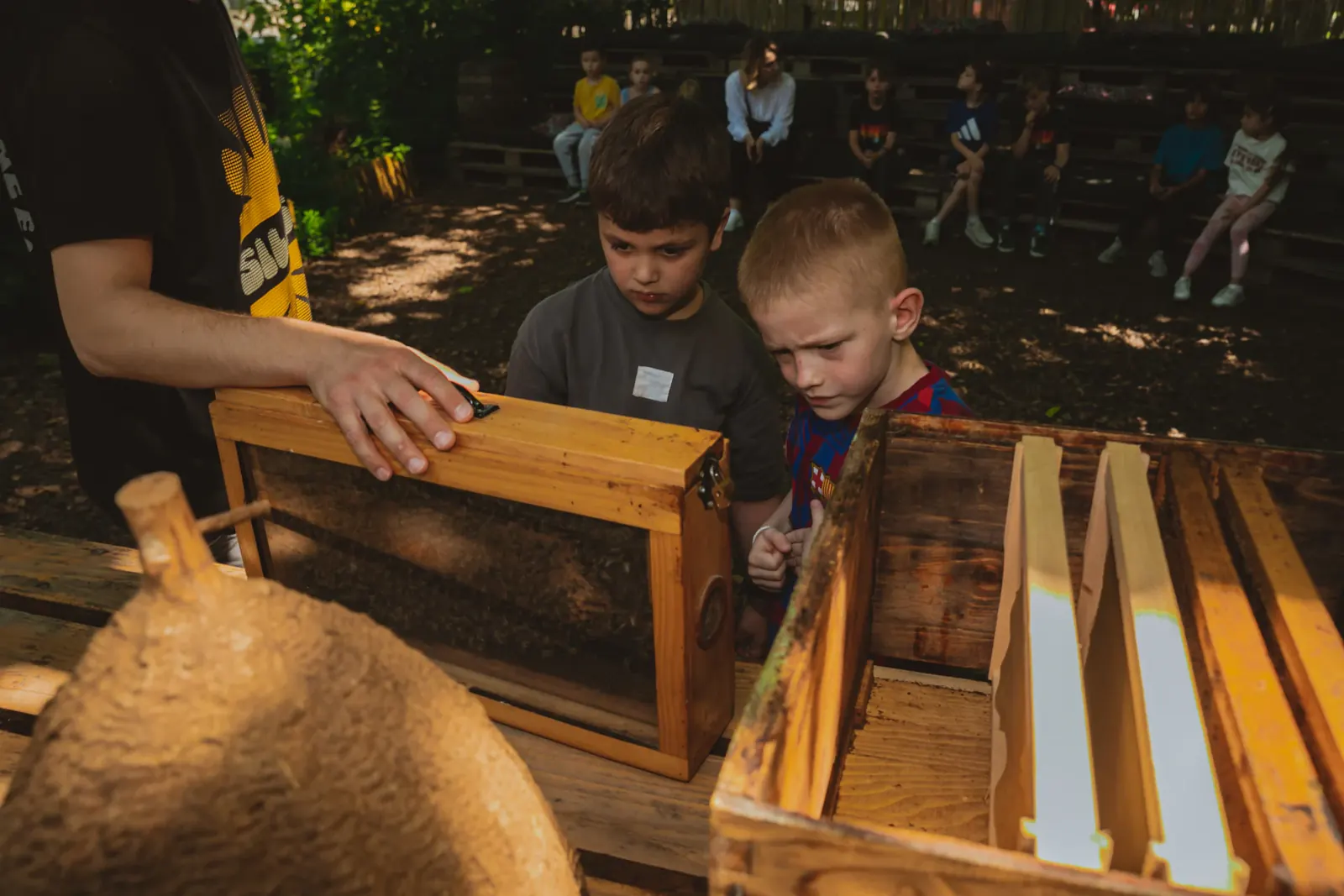
The first meeting happens through glass. A whole frame is visible at once: the workers, the brood and the queen somewhere among them.
The beekeeping suit
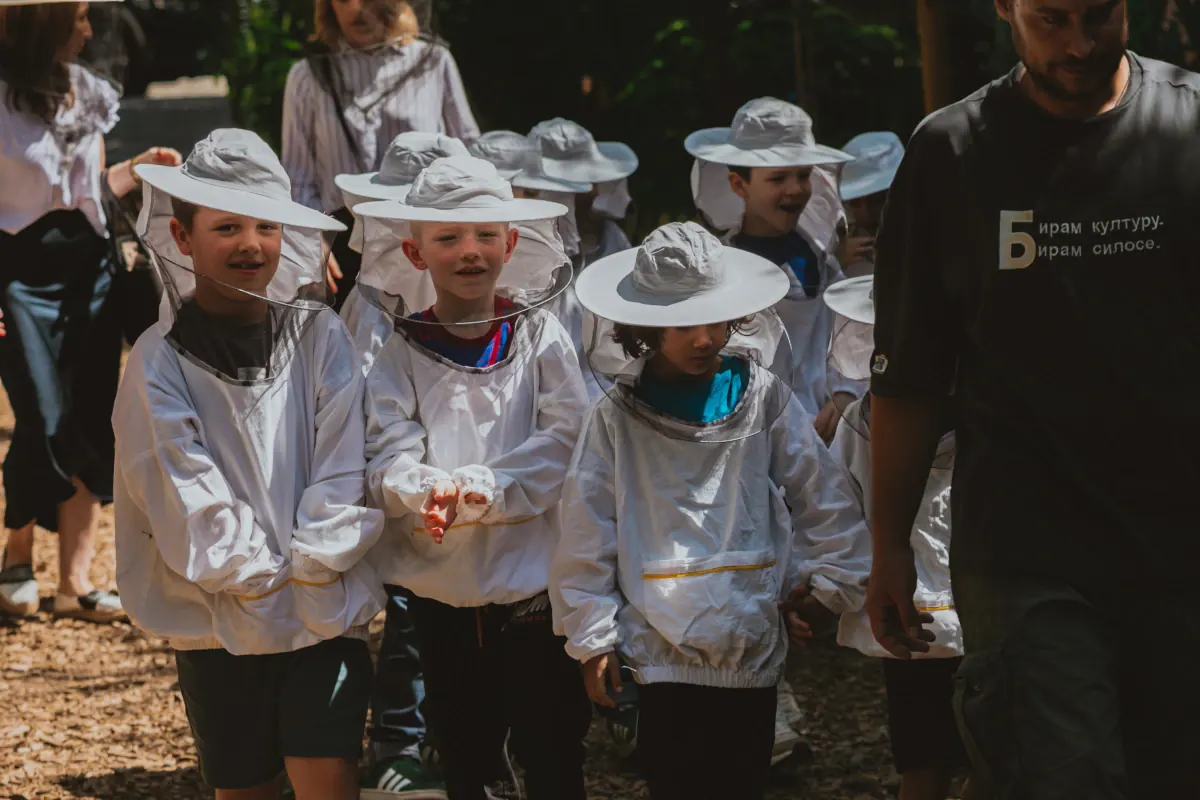
The suit is the real thing, with a hat and a veil. It goes on before a single hive is opened.
A frame of comb
The beekeeper lifts a frame out of a live hive and holds it so that everyone sees both sides. The bees stay on the comb and get on with their work.
The tasting
The honey is tasted from a wooden stick, only after you have seen where it comes from.
Time in the garden
After the programme the garden stays: the pallet amphitheatre, the huts painted with folk motifs, and shade. People usually stay longer than they planned.
03Why this is safe
The order of things is also the precaution
The first contact with a colony happens through glass, not through open air. The suit goes on before the lid comes off. The frame out of an open hive is held by the beekeeper.
The group is led by Dario and David Mardešić, who hold the EU certificate in apipedagogy and apitourism. Nobody has to come closer than they want to.
- Glass firstThe observation hive is closed. There is glass between the child and the colony.
- Suit before the lidThe hat and the veil go on before a single hive is opened.
- The beekeeper holds the frameDario or David lifts the frame and shows it to the group.
- No pushingAnyone who does not want to come closer watches from the second row. The programme does not change because of it.
- Allergies in advanceIf anyone in the group is allergic to stings, tell us in your enquiry.

The frame comes out of the hive.In the front row, nobody blinks.
04Parents
You are not in a waiting room
While the child works, you are in the same garden. The pallet amphitheatre, the shade and BeeFe, our own bar, are right there.
Whoever wants to goes along with the group to the hives. Whoever wants to sits down and waits to be called over to see what the child has found.
For adults who want the whole programme there is Dive into Hive: 2 hours, the suit, opening a hive, the api chamber and a tasting.

05Bee facts
Nine things about a hive that are easy to remember
This is what happens inside a single hive. Children take the answers home and retell them at the table.
50.000
bees can live in a single hive, and all of it runs like clockwork.
3
types of bee live in a hive: the queen, the workers and the drones, each with its own role.
Ženke
do almost everything you watch bees do: every worker in the hive is a female bee.
Nema
there is no single most important bee in a hive: the community survives through different roles and shared work.
Miris
says who belongs to a hive: bees recognise members of their own colony by scent.
Stražarice
guard the hive: they watch the entrance and decide who comes in.
Tačno
The brood temperature is held within a narrow range, so the young bees develop properly.
Bez žaoke
go the drones: their biological role is to mate with queens.
Isto jaje
begins both a queen and a worker: what the larva is fed decides which she becomes.
06Groups
A group can come here, and a hive can go to them
A kindergarten and a school have two routes to the same content. A birthday is the third, with a programme of its own.
We come to you
The Hive of Knowledge
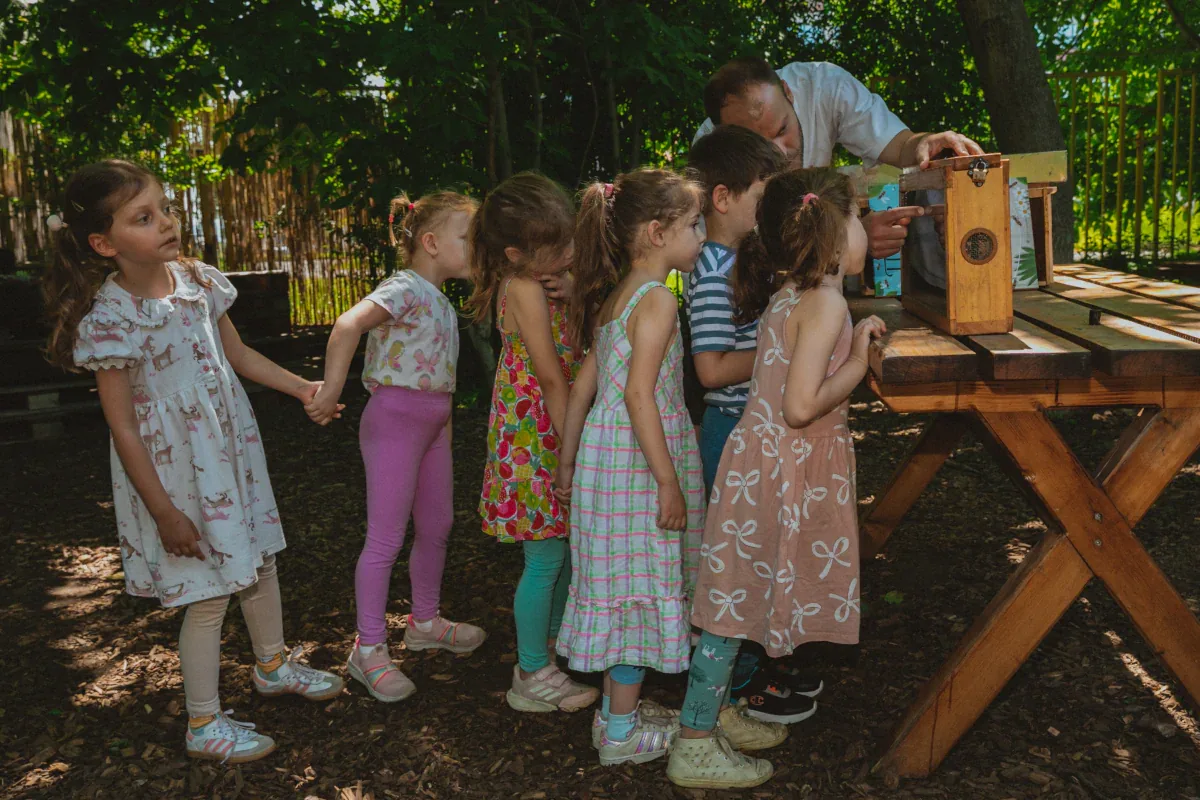
We bring the glass hive, the comb and the gear into the kindergarten or the school. The group does not have to travel anywhere.

You come to us
A group in the garden
A kindergarten or school group in the Honey Garden, in the same order: the glass, the suit, the frame, the tasting.

A separate programme
A birthday in the garden
A birthday among the hives, with bees and without screens.
07Dates and announcements
Workshops run through the season
Workshops and education sessions run through the season, and we announce new dates and programmes regularly. You can follow the news on our Instagram, or through membership in the Friends of the Honey Garden.
08Before you send an enquiry
The questions we get most often
From what age does this make sense?
The programme is adapted to the group, so tell us in your enquiry how many children are coming and how old they are. The glass hive, the comb frame and the tasting work even with the youngest.
Opening a live hive makes sense once a group can stand still next to the beekeeper.
What if a child gets frightened?
The first step is the glass, and that is where you see what a colony looks like before anything is opened. Anyone who does not want to come closer watches from the second row and stays with the group.
Do parents get a suit too?
Say in your enquiry how many adults would like a suit, and we will tell you what we can prepare for that slot.
We are coming as a kindergarten or a school. How does that work?
The group can come to the garden, or we come to you through the Hive of Knowledge, with the glass hive, the comb and the gear.
In your enquiry, tell us the number of children, their age, and whether you have your own space to work in.
What if someone is allergic to bee stings?
Tell us before you come, so that we know in advance. Part of the programme, the glass hive and the tasting, does not require going near an open hive.